
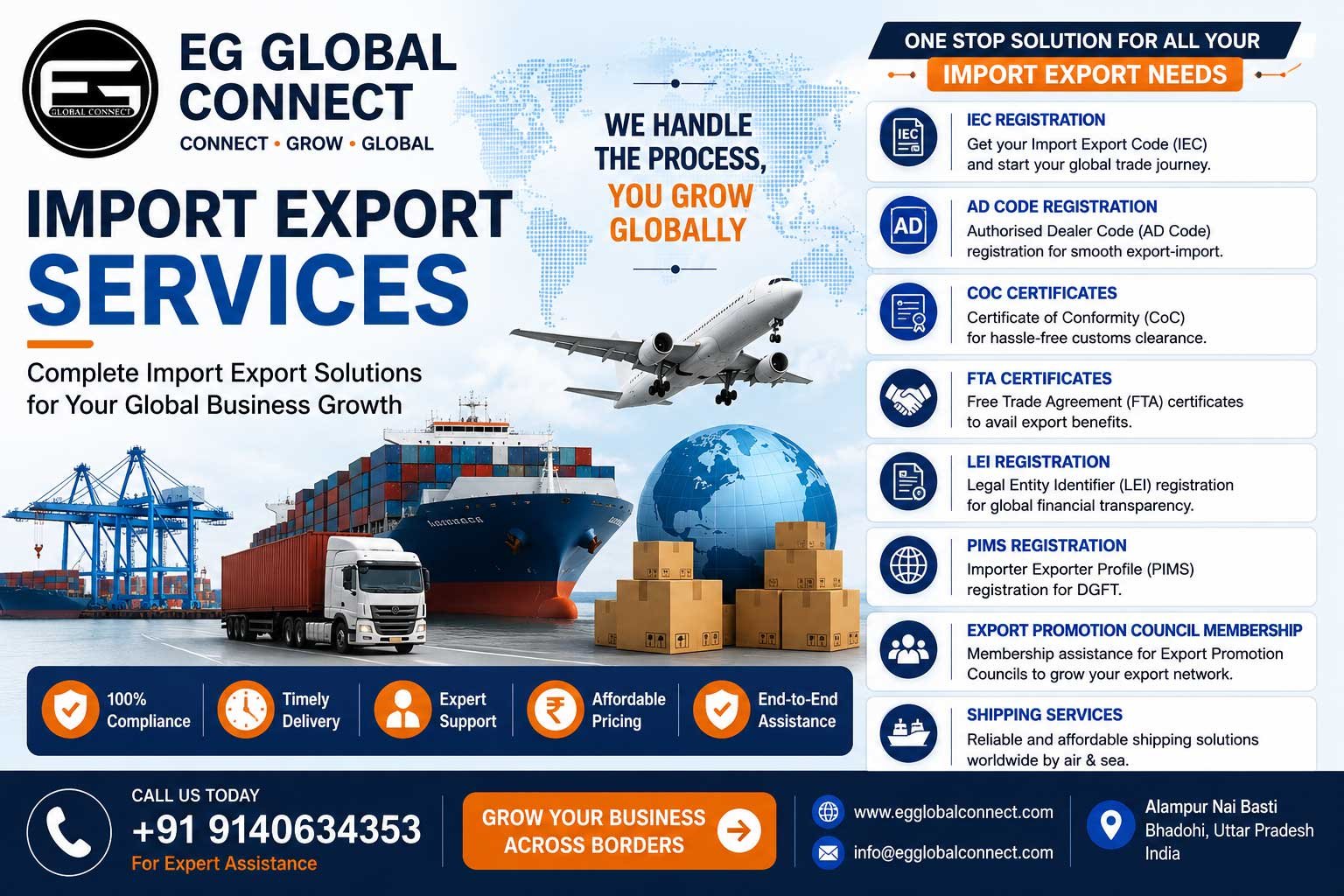
1. IEC Registration
The Import Export Code is the foundation — issued by DGFT, it's the single credential that makes your business legally able to import or export. No IEC means no shipping bill, no customs clearance, and no way to receive export payment through a bank. It's a one-time registration, but it needs to stay linked to your current PAN and bank details or it gets flagged during customs processing.
2. AD Code Registration
Your Authorised Dealer Code comes from your bank and tells customs which account your export proceeds should be tracked against. The catch most first-time exporters miss: AD Code registration is port-specific. If you ship from a different port or ICD later, you register the code there again before you can file a shipping bill from that location.
3. COC Certificates
A Certificate of Conformity confirms your goods meet the technical or safety standards of the destination country. For handicraft and carpet exporters, buyers in the EU and Gulf markets increasingly ask for this upfront — having it ready before a buyer asks shortens your sales cycle.
4. FTA Certificates
If you're exporting to a country India holds a Free Trade Agreement with, an FTA certificate (usually a Certificate of Origin) lets your buyer claim reduced or zero import duty. This is a genuine price advantage you can offer buyers — many exporters simply don't mention it, and lose deals to competitors who do.
5. LEI Registration
Legal Entity Identifier registration is required by RBI for entities carrying out transactions above specified thresholds, including certain large-value export remittances. If your average order size is climbing, get this done ahead of time rather than scrambling when a bank holds a transfer.
6. PIMS Registration
PIMS (Importer Exporter Profile) registration with DGFT keeps your exporter profile current and is checked during several other DGFT-linked processes. It's administrative, but skipping it creates friction later when you apply for benefits tied to your IEC.
7. Export Promotion Council Membership
Membership with the relevant Export Promotion Council (for carpet and handicraft exporters, this is typically CEPC) gives you access to RCMC certification, trade fair participation, and export incentive schemes. RCMC itself is often a prerequisite for claiming certain government export benefits.
8. Shipping Services
Once documentation is in place, reliable air and sea freight partners determine whether your shipment reaches the buyer on time and intact. For bulky, weight-heavy goods like carpets, sea freight is usually the cost-effective default; air freight is worth it only for smaller, time-sensitive, or high-value orders.
